

Get your textbooks and notebooks out because today we’re going in on the physiology of blood pressure. For you millennials out there, back when I was in school, a “textbook” was a large paper book with pages of words and “taking notes” meant opening a “notebook” made of “paper” and using a “pen” to “write” on said pages of paper. Sometimes we would even use a “highlighter” to help emphasize certain words or phrases. I also, in order to talk to my first girlfriend, I had to look up her home phone number in the school phone directory. I called, her father answered the phone, and I said, “I’m sorry, I have the wrong number.” Then I crawled into the fetal position and went to bed…

Ok. Here, we, go!
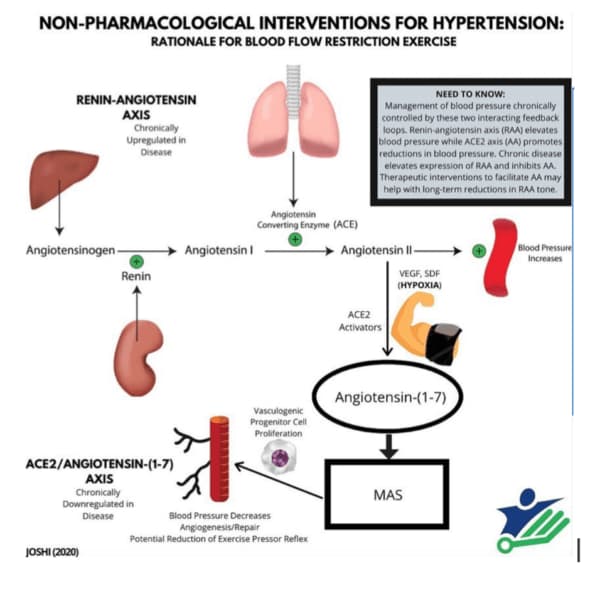
The renin-angiotensin axis (RAA) is the main pharmacological target for reducing hypertension due to its role in inducing increases in systemic vascular resistance. However, there is a counter-axis known as the ACE2/Angiotensin-(1-7)/MAS axis (AAA) that exists to counter-regulate the systemic changes produced by the RAA axis. Unfortunately, this axis has been shown to be inhibited in chronic diseases such as hypertension and diabetes. Non-pharmacological interventions like exercise may help restore the balance between axes to help reduce blood pressure and reduce reliance on pharmacology.
A recent study (Joshi, 2020) provides preliminary in-vivo evidence to suggest that an acute bout of low-load (10% 1RM) BFR leg extension exercise provides the acute cellular signaling required to stimulate recruitment of specialized cells known as hematopoeitic stem/progenitor cells through ACE2 activation. These cells are responsible for increasing vasculogenesis (creation of new vascular beds) and facilitating anti-hypertensive effects. In fact, regional hypoxia was negatively correlated to the expression of growth factors like vascular endothelial growth factor (VEGF) (-0.88) and stromal-derived factor-1a (SDF) (-0.85) and higher levels of hypoxia showed a favorable increase in ACE2/ACE levels (-0.92), suggesting an effect that may act to reduce inhibition of the RAA axis over time.
Providing non-pharmacological means to enhance quality of life is crucial and it appears that the hypoxia provided through BFR training may provide a novel therapeutic target for individuals with chronic disease that have an altered RAA.
SOURCE:
Joshi S, Mahoney S, Jahan J, Pitts L, Hackney KJ, Jarajapu YP. Blood flow restriction exercise stimulates mobilization of hematopoietic stem/progenitor cells and increases the circulating ACE2 levels in healthy adults. J Appl Physiol (1985). 2020 May 1;128(5):1423-1431. doi: 10.1152/japplphysiol.00109.2020. Epub 2020 Apr 23. PMID: 32324479; PMCID: PMC7272753.
Adapted from: https://www.instagram.com/p/CQXF0XbjxQr/
****Remember, the decision to use BFR, or any treatment for that matter, should be based on the pillars of evidence-based practice.
Are you ready to meet the growing demand as a Confident BFR Provider?
Be sure to check out our engaging 4-hour On Demand On-Line BFR Training course at www.BFRtraining.com
Our course is for both Rehab and Fitness professionals and will provide everything you will need to overcome the three hurdles for successful BFR Training and help guide you to become a Confident Successful BFR Provider.
Use the click this LINK for $75 off the original price! Or use coupon code BFR75 at checkout.