


Safety with BFR training is a top priority for researchers and clinicians alike. I mean, at the end of the day, we are wrapping a cuff around our limb to alter the flow of blood to our tissues…all while training at high-perceived efforts and with a significant amount of pain. Sounds like a normal Sunday, right?
Want to skip the plot and get right to the ending? Ok. Spoiler alert…if a patient is cleared for heavy strength training, they are most likely cleared for BFR training. Due to the novelty of the approach and the way in which training is performed through restriction of arterial flow, there are three common concerns when training with BFR:
Here are the main takeaways. As long as the patient is screened properly (see chart below):
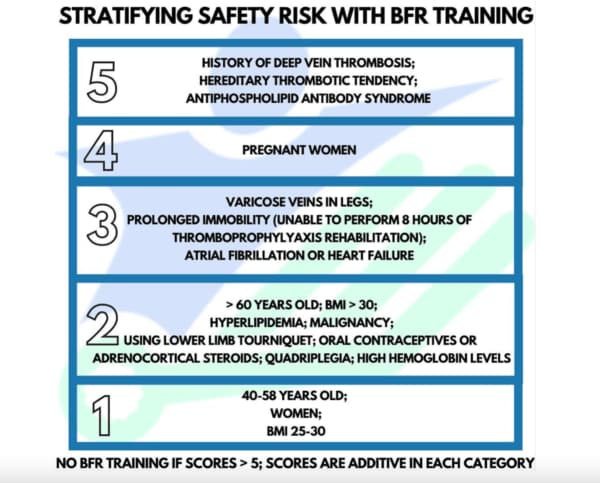
It can be helpful to not only have a framework for appropriate BFR candidacy (see our recent publication titled “Perceived Barriers to Blood Flow Restriction Training” in Frontiers in Rehabilitation Science – Open Access), but also a way to stratify risk. This chart was proposed in 2011 by Nakajima et al. as a way to help with the clinical decision-making process. This chart could be used in tandem with our screening algorithm to make the BFR screening process much more comprehensive.
References:
Nakajima et al. (2011). Key considerations when conducting KAATSU training. Int J KAATSU Training Res, 7:1-6.
Adopted from: https://www.instagram.com/p/CRwxxtGM3_G/
****Remember, the use of BFR training should not be based solely on a success story. The decision to use BFR, or any treatment for that matter, should be based on the pillars of evidence-based practice.
Are you ready to meet the growing demand as a Confident BFR Provider?
Be sure to check out our engaging 4-hour On Demand On-Line BFR Training course right HERE
Our course is for both Rehab and Fitness professionals and will provide everything you will need to overcome the three hurdles for successful BFR Training and help guide you to become a Confident Successful BFR Provider!